
Project Arc's Noah's Ark
For centuries, Noah's Ark has been portrayed as a giant rectangular vessel. Children's books, museum exhibits, films, and countless illustrations have reinforced that image until it has become almost unquestioned.
But where does that geometry come from?
Genesis provides Noah's Ark's measurements, construction details, purpose, and function. Yet nowhere does the text explicitly describe a rectangular hull.
That distinction matters.
Measurements describe size.
Purpose determines design.
Context determines geometry.
Project Arc investigates whether the exact same biblical measurements, interpreted within their literary, architectural, engineering, and hydrodynamic context, point to a different geometric interpretation.
The question is not whether the measurements are correct.
The question is what those measurements describe.
Could the biblical words translated length and breadth, when interpreted within their architectural context, describe diameter and radius rather than the sides of a rectangle?
If so, the measurements never changed.
The Hebrew text never changed.
Only the geometry.
Rather than beginning with modern shipbuilding assumptions, this investigation begins with Scripture.
What kind of vessel would God design to preserve life during a year-long global flood?
One optimized for navigation—
or one optimized for survival?
That single question shapes every page that follows.
From buoyancy and structural integrity to ventilation, displacement, and construction, this investigation examines Noah's Ark through the combined lens of Scripture, engineering, hydrodynamics, and context.
Every measurement deserves to be tested.
Every assumption deserves to be questioned.
Context of the Vessel
For generations, Noah's Ark has commonly been imagined as a giant floating shoebox—a massive rectangular barge drifting across the waters of a global flood. Children's books, church illustrations, films, and even many scholarly reconstructions have repeated this image so often that most people never stop to question it.
But what if the inherited image is not the original pattern?
What if the Ark described in Scripture was never intended to function like a conventional ship?
Project Arc investigates whether Noah's Ark may have originally followed a nonlinear, circumferential, and stability-centered design hidden in plain sight within the biblical text itself.
Not a warship.
Not a cargo ship.
Not a modern vessel.
A survival vessel.
Purpose determines design.
Context determines geometry.
_edited.jpg)


Genesis 6:13–17
13 And God said unto Noah, The end of all flesh is come before me; for the earth is filled with violence through them; and, behold, I will destroy them with the earth.
14 Make thee an ark of gopher wood; rooms shalt thou make in the ark, and shalt pitch it within and without with pitch.
15 And this is the fashion which thou shalt make it of: The length of the ark shall be three hundred cubits, the breadth of it fifty cubits, and the height of it thirty cubits.
16 A window shalt thou make to the ark, and in a cubit shalt thou finish it above; and the door of the ark shalt thou set in the side thereof; with lower, second, and third stories shalt thou make it.
17 And, behold, I, even I, do bring a flood of waters upon the earth, to destroy all flesh, wherein is the breath of life, from under heaven; and every thing that is in the earth shall die.

The Engineering Problem
Every engineered structure begins with a design objective.
Bridges carry loads.
Airplanes fly.
Submarines dive.
Ships navigate.
Before an engineer draws a single line, one question must first be answered:
What is this structure designed to do?
That same question should be asked of Noah's Ark.
The biblical objective was never transportation.
It was preservation.
Genesis records no rudder, sail, keel, mast, oars, steering system, propulsion, or destination. Noah was never instructed to navigate.
He was instructed to survive.
That distinction changes the engineering problem completely.
Modern ships are optimized for movement through water.
The Ark was optimized to preserve life upon it.
Once the design objective is understood, the biblical measurements can be examined without assuming they describe a conventional ship.
The question is no longer, "What shape do we expect?"
The question becomes, "What shape best fulfills the purpose God described?"

A Vessel Designed for the Storm
The Genesis Flood was not a calm ocean voyage.
It was a prolonged global catastrophe.
The vessel would have endured continuous wave loading, hydrostatic pressure, impact forces, turbulence, floating debris, and long-term structural fatigue.
Under these conditions, survivability becomes more important than speed.
Modern engineering repeatedly demonstrates that curved structures distribute compressive forces more efficiently than broad flat surfaces. Domes, shells, bowls, eggshells, bubbles, and countless biological structures rely on curvature to reduce stress concentrations while increasing structural efficiency.
The question is not which design looks most familiar.
The question is which design best fulfills the engineering purpose described in Scripture.


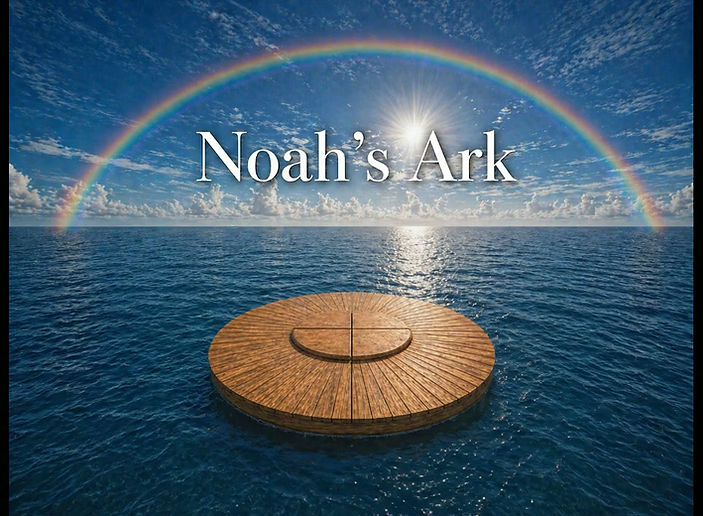
OMNIDIRECTIONAL HYDRODYNAMIC STABILITY
One of the greatest engineering challenges facing large rectangular vessels is directional wave loading. When waves strike broad, flat surfaces from different directions, they can generate rolling moments, torsional strain, slamming forces, and long-term structural fatigue.
Wave loading may be approximated by:
F = ½ρv²CdA
where:
ρ = fluid density
v = wave velocity
Cd = drag coefficient
A = exposed surface area
A nonlinear circumferential hull distributes hydrodynamic pressure around a continuous curved surface rather than concentrating it on broad flat panels and sharp corners. This geometry may reduce asymmetrical loading and the stresses associated with multidirectional seas.
In practical terms, there may be no mechanically preferred direction for the vessel to face.
Project Arc also investigates whether Noah's Ark possessed an exceptionally deep draft and large displacement. According to Archimedes' Principle:
Fb = ρgV
where displaced water volume determines buoyant force.
Greater displacement and a deeper draft increase resistance to rapid motion, allowing the vessel to absorb wave energy more gradually.
The engineering objective was never navigation, maneuverability, or speed.
It was:
Buoyancy.
Stability.
Structural endurance.
The preservation of life.

A couple of veterans from my woodworking club helped me build this
1:300-scale model of Noah's Ark.

Mentoring Hayden in woodworking, especially on the Noah's Ark models, has been a privilege. I've seen firsthand his dedication to the Bible and his careful pursuit of the truth. At first, the round Ark idea challenged me, but now I see the good sense in it. I respect Hayden and believe his perspective is worth serious consideration.
— John Adams
Retired U.S. Army, Disabled Veteran


Genesis 6:16a
“A window shalt thou make to the ark, and in
a cubit shalt thou finish it above"
Context Is King

Which dead-in-the-water vessel does science prefer?
What vessel would you and your family rather live on for about a year?
A long, narrow shoebox vessel—or a wide, stable round ark?
Would God design the inferior option, or the superior one?
You and science choose the round Noah's Ark 10/10 times.
σcr=3(1−ν2)E(Rt)
THE QUESTION OF SCALE
Using the common 18-inch cubit, the traditional rectangular Ark measures approximately:
-
450 feet long
-
75 feet wide
-
45 feet high
This produces approximately 101,000 square feet of usable floor space for the rectangular Noah's Ark.
Project Arc investigates whether the same biblical measurements, interpreted within their architectural context, could instead produce a nonlinear geometry approaching 370,000 square feet of usable interior space.
If so, the implications extend far beyond geometry.
Additional interior space would affect animal capacity, food storage, ventilation, natural lighting, circulation, waste management, and long-term habitability.
Curved walls may also contribute usable living area while improving structural continuity and environmental organization.
The question is not simply how the Ark looked.
The question is how the biblical measurements function.

THE WINDOW ABOVE
Genesis 6:16 records one of the Ark's most intriguing architectural details:
"A window shalt thou make to the ark, and in a cubit shalt thou finish it above."
This brief description has prompted centuries of interpretation.
Many traditional reconstructions place rows of small windows along the sides of a rectangular vessel.
Project Arc investigates whether the text instead describes a single centralized opening above.
If so, that design would naturally improve:
-
Ventilation
-
Moisture removal
-
Daylight penetration
-
Thermal circulation
-
Environmental regulation
Rather than relying on numerous side windows, the Ark may have used a single overhead opening to help regulate its internal environment throughout the Flood.
The question is not what later illustrations portray.
The question is what Genesis actually describes.


A LIVING ECOSYSTEM
Genesis records that Noah was commanded to b
ring representatives of the animal kinds aboard the Ark—but God also instructed him to gather every kind of food that would sustain both humans and animals throughout the Flood (Genesis 6:21).
The Ark was not simply a floating container.
It was a living ecosystem.
Food stores naturally produce seeds. Animals produce manure. Organic material decomposes. Combined with fresh rainwater, sunlight entering through the overhead window, and many months aboard the vessel, these resources may have made it possible for Noah to cultivate a small nursery of living plants.
Such a nursery could have supplied fresh vegetation for herbivorous animals, supplemented human nutrition, improved air quality, and helped recycle organic waste into fertile soil.
Animal waste, often viewed only as a problem, may instead have become part of a natural cycle. Composting converts manure into nutrient-rich growing material, while plants help return oxygen to the environment and absorb carbon dioxide. Rather than competing against one another, the people, animals, plants, food, water, and biological processes aboard the Ark may have functioned together in remarkable harmony.
The Ark was not merely designed to survive the Flood.
It may also have been designed to sustain life throughout it.
When the waters finally receded, Noah already possessed what every new beginning requires:
Living creatures.
Food.
Seeds.
Fertile soil.
And a growing nursery prepared for life on a renewed earth.

THE NOVGOROD COMPARISON
The Russian circular warship Novgorod (1874–1903) is sometimes cited as evidence against a round Noah's Ark. However, the two vessels were designed for entirely different purposes.
Novgorod was a heavily armored warship built for combat. It carried massive guns, engines, ammunition, and thick armor while requiring steering, propulsion, and maneuverability. Its high drag, slow speed, and handling limitations reflected those military demands.
Noah's Ark served an entirely different purpose.
Like Moses' ark, it was a vessel of preservation, not navigation. Scripture describes no rudder, mast, sail, oars, weapons, or destination. Instead, the Ark was designed to survive the Flood while preserving the lives entrusted to Noah.
Project Arc also proposes that Noah's Ark possessed a deep draft with relatively little structure projecting above the roof other than the Genesis 6:16 overhead skylight. In both purpose and engineering, it differs fundamentally from the top-heavy Russian warship.
The comparison is therefore not between two similar vessels.
It is between two completely different engineering problems.

.webp)
Fleet Admiral
Chester W. Nimitz
"The basic objectives and principles do not change."

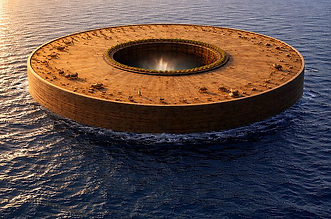
THE DEEP DRAFT
One of the most overlooked questions about Noah's Ark is not its length or width, but how deeply it rested in the water.
Project Arc investigates whether the Ark possessed an exceptionally deep draft. If so, much of its mass and displacement would have remained below the waterline, lowering its center of gravity and increasing resistance to rapid rolling and vertical motion.
Unlike a fast-moving ship designed to ride over waves, a survival vessel benefits from remaining deeply settled in the water. Greater displacement increases buoyant force, while a deep draft allows the vessel to absorb wave energy more gradually.
This concept agrees with one of the most fundamental principles of naval architecture:
The deeper and heavier the displacement, the greater the resistance to sudden motion.
If Noah's Ark functioned as a dead-in-the-water vessel with no propulsion or steering, stability—not speed—becomes the governing engineering objective.
Rather than climbing over every wave, the Ark may have been designed to endure them.
The question is not how quickly the Ark could travel.
The question is how safely it could preserve life throughout the Flood.


AN ANCIENT PARALLEL
Dr. Irving Finkel of the British Museum translated a 3,770-year-old Mesopotamian flood tablet describing a massive round, coracle-like survival vessel associated with Atrahasis, a figure often compared with Noah. The vessel begins from a central measuring line and expands outward circumferentially, reflecting a fundamentally nonlinear architectural approach unlike the traditional rectangular Ark. His research was published in The Ark Before Noah (2014).
For Project Arc, Scripture remains the ultimate authority—not archaeology. Archaeological discoveries cannot determine the meaning of Genesis, but they can provide valuable historical context.
The Ark Tablet demonstrates that large, round flood vessels were a genuine concept in the ancient Near East, encouraging us to reexamine ancient engineering, measurement systems, and whether later architectural traditions have influenced how we visualize Noah's Ark today.


TWO ARKS. ONE PURPOSE.
The Bible never calls Noah's Ark a ship. Instead, it uses the Hebrew word tevah (תֵּבָה), the same word used for Moses' floating ark in the Nile. In both accounts, the tevah is a vessel of preservation rather than a navigational craft.
Project Arc asks whether this shared terminology points to an ark engineered for buoyancy, endurance, and the preservation of life rather than travel.
Biblical Hebrew
תֵּבָה (tevah) — Noah's Ark and Moses' Ark
אֲרוֹן (aron) — the Ark of the Covenant
One preserves life.
The other preserves God's covenant.
Context is King.


ENGINEERING PRINCIPLES
Modern hydrodynamics, naval architecture, and structural engineering all recognize that geometry influences how forces are distributed throughout a structure.
During the Genesis Flood, Noah's Ark functioned as a dead-in-the-water survival vessel, not a ship under sail or power.
A vessel survives severe seas through its restoring moment—the force that returns it toward an upright position after being displaced by waves.
RM = Δ × GM × sin(θ)
Buoyancy is governed by Archimedes' Principle:
Fb = ρgV
Curved geometry tends to distribute loads more uniformly, while flat surfaces and sharp corners concentrate stress.
Project Arc therefore asks a simple engineering question:
Which dead-in-the-water survival vessel would you choose?
A nonlinear circumferential vessel—
or
a traditional rectangular "shoebox" vessel?

Ship? Ark?

I think we're getting close to something special. Even traditional 300 x 50 x 30
box-shaped Ark reconstructions often add a curved hull
to improve seaworthiness.
Then there's Genesis 6:16a. Could the biblical measurements and construction details point to a different geometry?
Project Arc investigates that possibility.


OMNIDIRECTIONAL HYDRODYNAMIC STABILITY
One of the greatest engineering challenges facing large rectangular vessels is directional wave loading. When waves strike broad, flat surfaces from different directions, they can generate rolling moments, torsional strain, slamming forces, and long-term structural fatigue.
Wave loading may be approximated by:
F = ½ρv²CdA
where:
ρ = fluid density
v = wave velocity
Cd = drag coefficient
A = exposed surface area
A nonlinear circumferential hull distributes hydrodynamic pressure around a continuous curved surface rather than concentrating it on broad flat panels and sharp corners. This geometry may reduce asymmetrical loading and the stresses associated with multidirectional seas.
In practical terms, there may be no mechanically preferred direction for the vessel to face.
Project Arc also investigates whether Noah's Ark possessed an exceptionally deep draft and large displacement. According to Archimedes' Principle:
Fb = ρgV
where displaced water volume determines buoyant force.
Greater displacement and a deeper draft increase resistance to rapid motion, allowing the vessel to absorb wave energy more gradually.
The engineering objective was never navigation, maneuverability, or speed.
It was:
Buoyancy.
Stability.
Structural endurance.
The preservation of life.
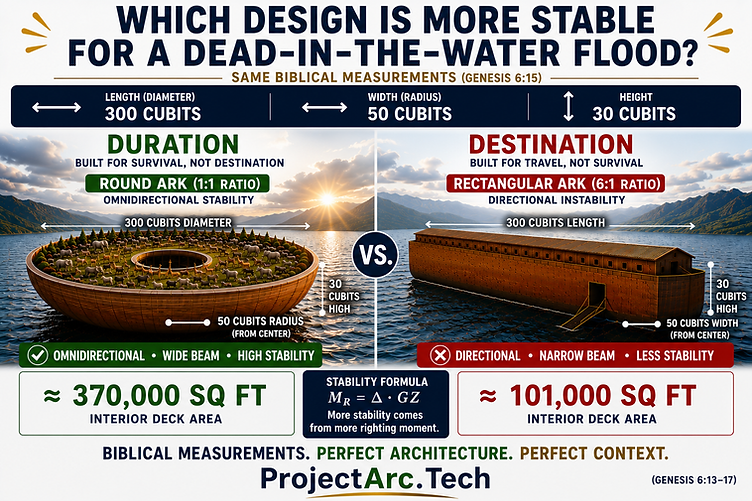
Words such as ark, chest, box, vessel, and container describe function—not geometry.
Their shape is determined
by words & context.


Biblical Measurements.
Contextual Architecture.